
Ceramides After Menopause: What the Skin Barrier Research Shows
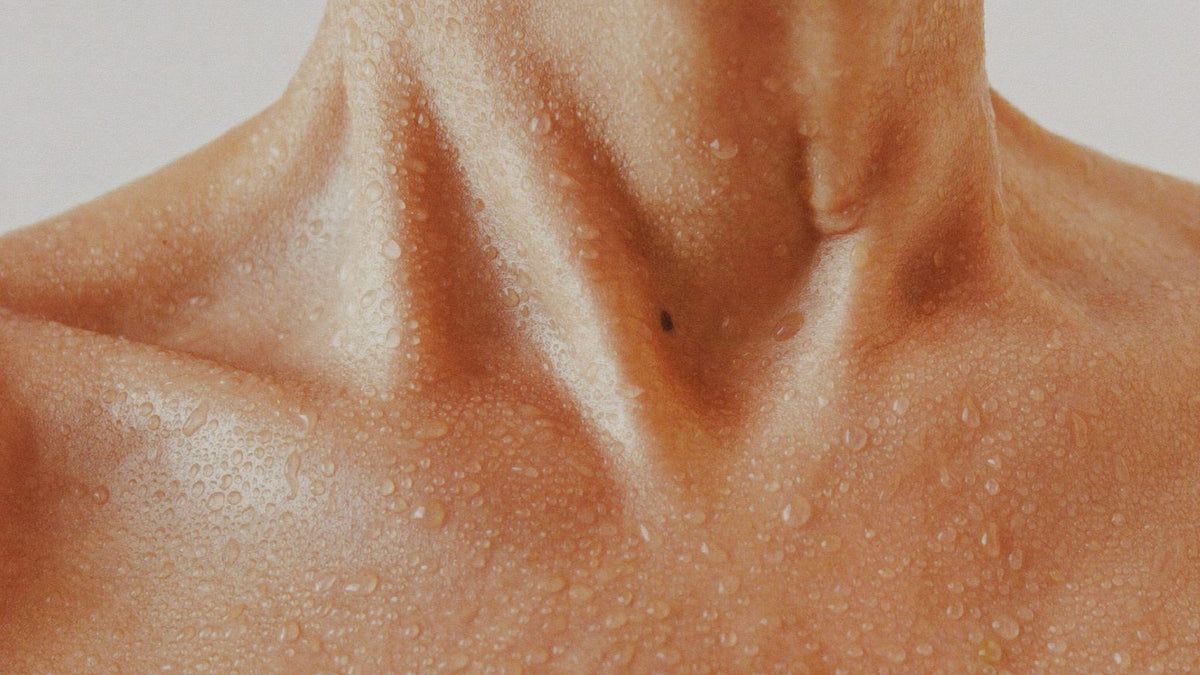
After menopause, skin holds fewer ceramides, the fats that act like mortar between skin cells, and the ones that remain have shorter chains, which leaves the barrier leakier. A 2022 study in Scientific Reports found this pattern in postmenopausal women and tied it to higher water loss and lower skin capacitance, and it was absent in women on hormone replacement therapy.
- What actually breaks down in the skin's barrier after menopause?
- How do researchers know estrogen is the cause?
- What does the itch itself look like at the lipid level?
- Can fulvic acid calm an overreactive skin barrier?
- Does pearl powder contain anything the barrier is missing?
- Where does silicon fit into skin structure?
- Common questions about ceramides and skin after menopause
What actually breaks down in the skin's barrier after menopause?

Picture the outer layer of skin as a brick wall. The skin cells are the bricks. Ceramides, along with cholesterol and fatty acids, are the mortar packed between them. That mortar is what keeps water inside the skin and irritants outside.
A 2022 study in Scientific Reports measured that mortar directly in postmenopausal women and found two problems at once. There were fewer ceramides overall, and the ceramides present had a shorter average chain length than they should. Shorter-chain ceramides pack together less effectively, and the study tied that directly to two measurable outcomes, higher transepidermal water loss and lower skin capacitance, the two standard measures of a compromised barrier.
The keratinocyte experiment closes the loop
The same research team went a step further. When they applied estradiol directly to primary human keratinocytes, the skin cells that manufacture ceramides, production of those ceramides rose. That single experiment is what turns "postmenopausal skin has fewer ceramides" from an observation into a mechanism with a driver behind it.
How do researchers know estrogen is the cause?
Age alone could explain a lot of skin changes. What makes this particular study unusually convincing is the comparison group it included.
- The postmenopausal ceramide-shortening pattern was present in women not on hormone therapy
- That same pattern was absent in the group taking hormone replacement therapy
- Estradiol applied directly to skin cells in the lab raised ceramide production
- All three findings point the same direction, at estrogen specifically, not at the passage of time alone
That is the difference between a correlation and a cause. A lot of skin research can only say two things happened around the same time. This study built in the one comparison that separates "menopause happened" from "estrogen loss did this."
What does the itch itself look like at the lipid level?

A separate 2020 study in Lipids in Health and Disease looked specifically at people with senile pruritus, chronic itching without an obvious rash, and measured the surface lipid composition of their skin directly.
- Pruritus patients showed significantly higher transepidermal water loss than controls
- Their skin surface lipid composition was measurably altered compared to non-itchy skin
- The lipid disruption tracked with the itch itself, not just with dryness in general
That study did not test menopausal women specifically, and that gap stays flagged here. What it does is close the loop between the ceramide-barrier mechanism above and the actual felt symptom. A disrupted lipid layer and an itchy, reactive barrier travel together in the research literature.
Why this is a structural problem, not just a hydration one
A moisturizer adds water to the surface. It does not rebuild the ceramide chains inside the barrier itself. That distinction matters because it explains a pattern a lot of women describe. Moisturizing helps for an hour and then the tightness comes right back, because the underlying mortar was never replaced.
Can fulvic acid calm an overreactive skin barrier?
The clearest human evidence on fulvic acid and reactive skin comes from a placebo-controlled crossover trial in 30 adult volunteers with a documented hypersensitivity skin reaction. Participants took an oral fulvic acid preparation twice daily.
- The standard hypersensitivity reaction marker, wheal diameter, shrank from 6.63mm to 4.97mm on fulvic acid, a 25% reduction, statistically significant
- The placebo group barely moved, from 7.03mm to 6.73mm, a 4% change that was not significant
- 81% of the fulvic acid group improved, compared with 62% on placebo
- The study authors described fulvic acid as an inhibitor of the immediate hypersensitivity reaction, and noted it is systemically available after oral dosing
This trial did not test shilajit specifically, and it did not measure ceramides. It tested a related fulvic acid preparation on a different marker of skin reactivity. We describe it at exactly that level, a related compound with real human data on skin hypersensitivity, not a shilajit-barrier trial.
Does pearl powder contain anything the barrier is missing?

This is the newest and most specific piece of the Trifecta puzzle. A laboratory analysis of nacre, the iridescent material inside pearl shell that pearl powder is made from, examined its lipid fraction directly.
The nacre lipid extract was found to contain ceramides, the same molecule class that postmenopausal skin runs short on. The researchers also found the extract increased filaggrin, a protein essential to barrier formation, and decreased transglutaminase activity in a pattern consistent with rebuilding the stratum corneum's intercellular cement. The stated aim of that original research was exploring nacre for atopic dermatitis.
- The finding is a laboratory material analysis, not a human skin trial
- No study has tested oral pearl powder, at the dose in the Trifecta, against a ceramide or barrier endpoint in postmenopausal women
- What it actually establishes is that the raw material contains a molecule class directly relevant to the exact deficit the 2022 menopause study measured
The 3x fibroblast finding, for context
A separate in vitro study found pearl extract tripled fibroblast migration in a wound-healing model and shifted collagen production toward type III, the faster-laying, regenerative type. That is a different mechanism than the ceramide finding above. It rebuilds the layer beneath the barrier rather than the barrier's own lipid cement, and it belongs here only as related evidence, not combined proof.
Where does silicon fit into skin structure?
Silicon's best-established role in skin is as a crosslinking mineral, helping the collagen scaffold beneath the surface hold its shape. That is a different layer of the skin than the ceramide-rich barrier sitting above it, and both matter for different reasons.
A placebo-controlled trial of choline-stabilized orthosilicic acid, the gold-standard silicon compound in skin research, improved skin microrelief and mechanical properties in women with photodamaged skin. That trial measured skin surface texture and elasticity, not the ceramide layer specifically, and it used a different silicon form than the bamboo-derived silica in the Trifecta. We cite it as supporting evidence for silicon's broader role in skin structure, not as a ceramide finding.
| Ceramide barrier (surface) | Silicon crosslinking (deeper structure) | |
|---|---|---|
| What it does | Seals water in, blocks irritants | Reinforces the collagen scaffold |
| Menopause effect measured | Fewer, shorter ceramides (2022 study) | Not directly tested on this endpoint |
| Trifecta ingredient | Pearl powder (nacre lipids) | Bamboo silica |
| Human evidence level | Laboratory material analysis | Placebo-controlled RCT (different silicon form) |
Neither layer has been tested with all three Trifecta ingredients combined, and this table exists to make that honest.
What can you do for reactive, itchy skin day to day?
A few habits support the same barrier these studies describe, regardless of any supplement.
- Use lukewarm rather than hot water, since heat strips surface lipids faster than it cleans
- Apply moisturizer within a few minutes of bathing, while some surface moisture is still present
- Choose fragrance-free products, since added fragrance is a common trigger for reactive skin
- Run a humidifier in dry seasons, since low ambient humidity accelerates water loss through a weakened barrier
- Avoid over-exfoliating, which can strip the ceramide layer faster than skin can rebuild it
Common questions about ceramides and skin after menopause
What are ceramides, and why do they matter for menopausal skin?
Ceramides are fat molecules that sit between skin cells like mortar between bricks, holding the outer skin barrier together. A 2022 study found postmenopausal skin holds fewer ceramides with shorter average chain length, and shorter ceramides are linked to a leakier barrier and more water loss.
How do we know estrogen loss, not just aging, causes this?
The 2022 study included a group of postmenopausal women on hormone replacement therapy. The ceramide-shortening pattern was absent in that group, which is the detail that turns this from a correlation into evidence of estrogen's role specifically.
Does the Trifecta contain actual ceramides?
Not directly. What the research shows is that nacre, the material inside pearl powder, contains its own lipid fraction that has been found to include ceramides in laboratory analysis, alongside separate human research on fulvic acid and silicon's effects on skin. We describe each finding at the evidence level it actually supports.
Has any Trifecta ingredient been tested on menopausal skin barrier specifically?
Not as a combined formula, and we say so directly. The nacre lipid finding, the fulvic acid hypersensitivity trial, and the silicon skin RCT were each tested separately, in different populations, for different endpoints. No study has combined shilajit, pearl powder, and bamboo silica in one trial.
Is the Trifecta safe for sensitive, itchy skin?

the Optimum Shilajit Trifecta
Shilajit's fulvic acid, pearl powder's nacre lipids, and bamboo silica are each grounded in the separate research described above, and together they are the three ingredients in the Optimum Shilajit Trifecta, sourced from the Altai mountains and third-party tested for purity on every batch. No trial has combined all three on a postmenopausal ceramide or barrier endpoint. That is not a result the research has actually shown, so it does not get implied.
See the Optimum Shilajit TrifectaSources
- Menopause is associated with a shortened skin ceramide profile, reversed by hormone replacement therapy. Scientific Reports, 2022. https://pmc.ncbi.nlm.nih.gov/articles/PMC9755298/
- Ma X, et al. Lipidomic analysis of skin surface lipids in senile pruritus. Lipids in Health and Disease, 2020. https://www.ncbi.nlm.nih.gov/pmc/articles/PMC7364579/
- Menopause, menstrual cycle, and skin barrier function: a review. Skin Research and Technology, 2025. https://pmc.ncbi.nlm.nih.gov/articles/PMC12206585/
- Rousseau P, et al. Nacre lipid extract and stratum corneum reconstitution. Comparative Biochemistry and Physiology B, 2006. https://pubmed.ncbi.nlm.nih.gov/16877020/
- Gandy JJ, et al. Phase 1 clinical study of the acute and subacute safety and proof-of-concept efficacy of carbohydrate-derived fulvic acid. Clinical Pharmacology: Advances and Applications, 2012. https://pubmed.ncbi.nlm.nih.gov/22427734/
- Barel AO, et al. Effect of oral intake of choline-stabilized orthosilicic acid on skin, nails and hair in women with photodamaged skin. Archives of Dermatological Research, 2005. PMID 16205932.
- Pearl extract effects on fibroblast migration and collagen type III expression, in vitro wound-healing model, 2013. https://pubmed.ncbi.nlm.nih.gov/23043617/