
Silent Spine Fractures After Menopause and Why Two Thirds Go Unnoticed
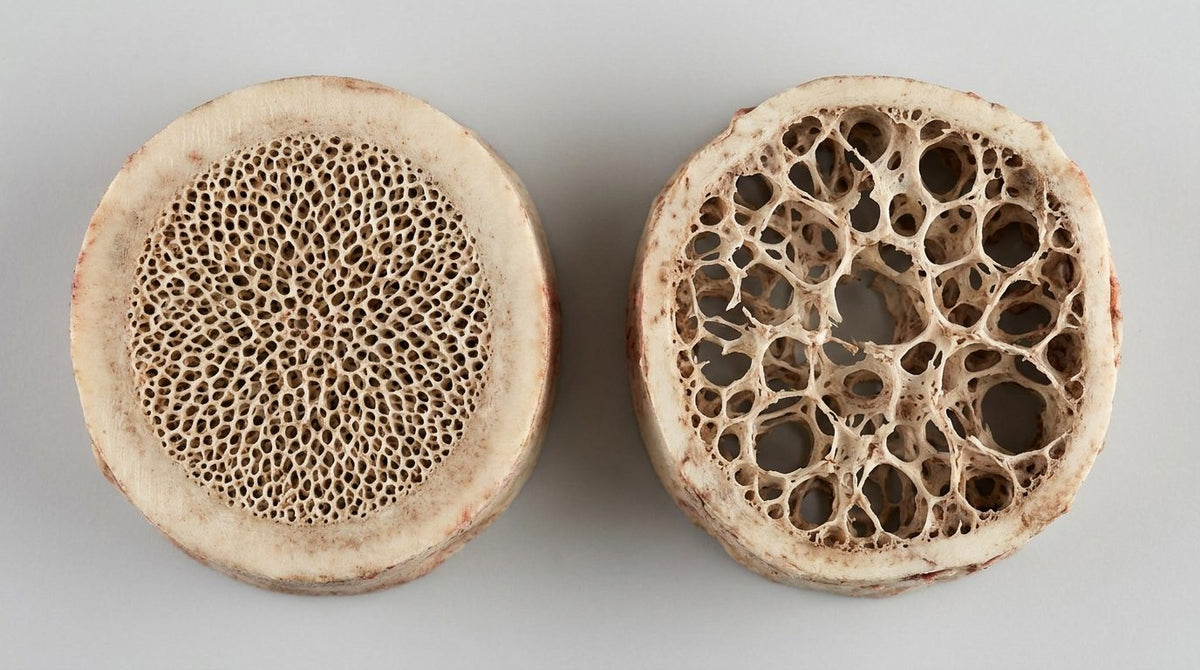
More than two thirds of spinal compression fractures are found by accident, on an X-ray ordered for something else, according to a 2016 review in American Family Physician. More than 700,000 Americans have one every year. For many women the break never feels like a break at all, just a backache that arrives, lingers and gets filed under "getting older." Shilajit, a mineral-rich resin studied in a 48-week trial of postmenopausal women with osteoporosis, is one of the few approaches shown to raise bone density in the very tissue these quiet fractures start in.
In this article - Why can a spine fracture happen without you knowing? - Does a silent fracture still cause back pain? - What do the warning signs actually look like? - What does the shilajit research show for spine and hip bone? - Common questions about silent spine fractures
Why can a spine fracture happen without you knowing?

The bones of the spine, called vertebrae, are stacked like short drums. Each one is mostly spongy inner bone, a honeycomb of tiny struts, wrapped in a thin shell. That honeycomb is the tissue that thins fastest after menopause, because it is remodeled more often than dense bone.
When the struts weaken, a vertebra does not snap the way a wrist does in a fall. It can slowly compress, the front edge sinking a few millimeters under ordinary body weight. No fall, no crack, no moment she can point to.
McCarthy and Davis, writing in American Family Physician in 2016, put the scale plainly. More than two thirds of people with a vertebral compression fracture are asymptomatic and are diagnosed incidentally. The same review notes these fractures can lead to chronic pain.
Why the quiet ones matter most
A hip fracture is impossible to miss. A spine fracture can go years without a name. That gap is the problem, because one compressed vertebra changes the load on the ones above and below it.
Three things tend to be true of silent spine fractures, and each one explains why they slip through.
- They are rarely sudden. Many build up across weeks or months.
- They are often mistaken for muscle strain, so nobody looks at the bone.
- They are a marker. A spine that has already compressed once is a spine whose bone has thinned.
Does a silent fracture still cause back pain?

Yes, and the data comes from one of the largest bone studies ever run. The Study of Osteoporotic Fractures followed 7,223 women aged 65 and over, taking spine X-rays about 3.7 years apart. Nevitt and colleagues published the results in the Annals of Internal Medicine in 1998.
A new vertebral fracture raised the odds of back pain, back disability, bed rest and limited activity, with odds ratios from about 2.0 up to 7.9. Women with a new fracture had about 10 more limited-activity days a year. The authors wrote that new vertebral fractures, even those not recognized clinically, are associated with substantial increases in back pain.
The women with a new break in their spine had a lot more back pain. That included the breaks nobody had caught.
| A fracture nobody has noticed | A fracture that has been found | |
|---|---|---|
| How it often feels | A dull ache, written off as age | Sharp pain or a clear event |
| Who is watching the bone | Nobody yet | A scan and a plan |
| What the research shows | Still raises back pain and limited days | Same bone, same thinning |
| Where the cause sits | In the thinning honeycomb bone | In the thinning honeycomb bone |
The pain is real and it has a physical source. It is not a sign of getting older, it is a sign the bone underneath has less in it than it used to.
What do the warning signs actually look like?

No single sign says "fracture." Together they are worth noticing.
Here are the traces a compressed vertebra tends to leave behind.
- Height loss. Losing an inch or more across the years is a common trace of compressed vertebrae.
- A rounding upper back, sometimes called a dowager's hump.
- A shorter reach to the top shelf, because the spine itself has shortened.
- A backache that is worse standing or walking and eases lying down.
- Pain that starts without any fall or lift.
- Clothes fitting differently through the waist and ribs.
Bone loss runs fastest in the years around the final period, which is why these signs so often appear in a woman's late fifties and sixties.
The cellular driver is well mapped. Estrogen falls, and the balance tips toward breakdown.
Three players decide that balance, and each has one job.
- RANKL switches bone-breaking cells on.
- OPG is the brake that holds RANKL back.
- Estrogen keeps the brake strong.
What does the shilajit research show for spine and hip bone?

Pingali and Nutalapati published a randomized, double-blind, placebo-controlled trial in Phytomedicine in 2022, run at Nizam's Institute of Medical Sciences. It enrolled 60 postmenopausal women for 48 weeks. Their average hip T-score was -2.5, the osteoporosis line, and they were not allowed to take calcium or vitamin D during the trial.
Hip bone density rose on shilajit and fell in the women who did not take it. Every single woman who took it reversed her osteoporosis. That result sits on the full trial page at our clinical trial research page. OPG, the brake on bone breakdown, rose 57.3%, and RANKL fell 9.8%.
Fulvic acid, the organic carrier that makes up much of purified shilajit, is credited with this effect. It is not a hormone. It supports the body's own estrogen signaling.
Zero serious adverse events appeared in the trial or in any human shilajit study.
The cell work points the same way.
Three findings from the wider research line up with the trial.
- Human bone cells. Azizpour and colleagues (2020) found shilajit lowered RANKL and raised OPG.
- The same two signals moved in the women in the Pingali trial.
- No calcium or vitamin D was needed for the density result.
The wider bone library is on our shilajit bone research page.
For women who recognize a quiet backache in this article, the practical point is the bone, not the pain. Pain relief alone leaves the thinning honeycomb exactly as it was.
In this article - [Why can a spine fracture happen without you knowing?](#why-can-a-spine-fracture-happen-without-you-knowing) - [Does a silent fracture still cause back pain?](#does-a-silent-fracture-still-cause-back-pain) - [What do the warning signs actually look like?](#what-do-the-warning-signs-actually-look-like) - [What does the shilajit research show for spine and hip bone?](#what-does-the-shilajit-research-show-for-spine-and-hip-bone) - [Common questions about silent spine fractures](#common-questions-about-silent-spine-fractures)
Can you have a broken bone in your spine and not know it?
Yes. A 2016 review in American Family Physician reported that more than two thirds of people with a vertebral compression fracture have no clear symptoms, and the break is found by accident on an X-ray ordered for something else.
How common are spinal compression fractures?
More than 700,000 Americans have a vertebral compression fracture every year, according to the same 2016 American Family Physician review. Most of them are tied to thinning bone, and most are never felt as a single dramatic event.
Do silent spine fractures still cause back pain?
Yes. The Study of Osteoporotic Fractures followed 7,223 women aged 65 and over, and a new vertebral fracture raised back pain, back disability and limited activity days, even when the fracture had never been recognized clinically.
Why does the spine break first in osteoporosis?
Spinal vertebrae are mostly spongy inner bone, the tissue that thins fastest after menopause. When that honeycomb weakens, the front of a vertebra can slowly collapse under ordinary body weight, with no fall and no single moment of injury.
Can bone density improve once spine bone has thinned?
In a 48-week randomized trial of 60 postmenopausal women with an average hip T-score of -2.5, every single woman who took shilajit reversed her osteoporosis, while hip density fell in the women on placebo. No calcium or vitamin D was allowed.

Optimum Shilajit
Optimum Shilajit is purified resin from the Altai mountains, third-party tested for heavy metals with results published. Two tablets with breakfast, made in small batches by a family-owned company out of Florida, with a 90-day money-back guarantee.
See Optimum Shilajit