
Bone Strength After Menopause: Beyond Calcium
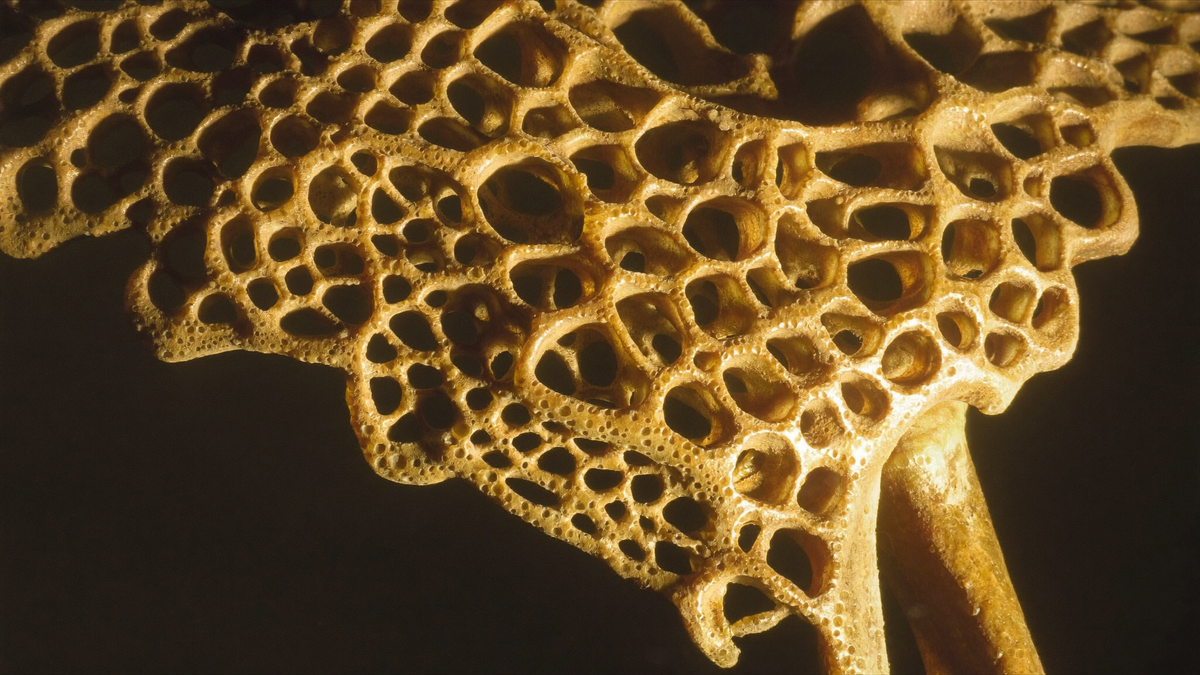
Bone weakens after menopause because 3 things tip the balance toward breakdown, and none of them is a calcium shortage. Oxidative stress damages the cells that build bone, low grade inflammation speeds up the cells that dissolve it, and the signal to rebuild slows. That is why strong bone needs a healthy collagen frame, not just more calcium.
Why do bones get weaker after menopause?
Bone is not static. Tiny cells are constantly dissolving old bone and laying down fresh bone, and for most of your life the two stay in balance. After menopause that balance tips toward breakdown.
The reasons are not what most bone advice tells you. Three things drive the loss:
- Oxidative stress rises and damages the cells that build new bone.
- Low-grade inflammation speeds up the cells that dissolve old bone.
- The signal to rebuild slows down, so new bone cannot keep pace with what is being removed.
Notice that none of those is a calcium shortage. That is the piece most bone advice skips, and it is why the answer has to go further than the calcium aisle.
If it is not just calcium, what is bone actually made of?
Bone is roughly one-third protein and two-thirds mineral. The protein is collagen, a flexible framework that gives bone its spring. The minerals are the hard crystals packed onto that frame.

Picture reinforced concrete. The collagen is the steel rebar inside, and the calcium is the concrete poured around it. Concrete with no rebar is brittle and cracks under load. Bone works the same way. Without a healthy collagen frame, piling on more calcium just makes bone harder and more fragile, not stronger.
That frame needs more than calcium to hold together.
- Silicon helps build and crosslink the collagen scaffold. In a placebo-controlled trial in women with thinning bones (Spector and colleagues, 2008), a bioavailable form of silicon raised the markers of new bone formation.
- A spread of trace minerals, not just one, is what the living matrix draws on as it rebuilds.
So bone strength is a matrix problem, not a single-mineral problem. That reframes what actually helps.
Why does taking more calcium often fall short?
Most postmenopausal women already get enough calcium, and adding more on top rarely fixes what is driving the loss. Calcium is necessary, but on its own it is seldom the missing piece.

Two reasons it underdelivers:
- Calcium has to deposit onto a healthy collagen frame. If the frame is weakening, extra calcium has nowhere good to go.
- Calcium does nothing about the oxidative stress and inflammation that are actively tearing bone down after menopause.
This is the gap shilajit speaks to. It carries a broad spread of trace minerals into the body, supports the collagen side of the matrix, and the research shows it calming the very oxidative load that drives the loss.
What does the research show about shilajit and bone?
The strongest piece of evidence is a 48-week trial. Pingali and colleagues (2022), in Phytomedicine, followed 60 postmenopausal women with osteopenia. Every single woman in the treatment group reversed her osteopenia within 24 weeks, bone density was preserved dose-dependently, and the study recorded zero side effects.
The trial is Pingali and Nutalapati, published in Phytomedicine in 2022, and it followed 60 postmenopausal women for 11 months. Their average hip T-score at the start was -2.5, which is osteoporosis. Hip bone density rose in the women taking shilajit and kept falling in the women who did not, and none of them were allowed to take calcium or vitamin D. Every single woman in the treatment group reversed her osteoporosis.
The full results, including the hip T-scores for each group, are on the shilajit osteoporosis clinical trial page.

Just as telling is how it happened. The same trial found shilajit reduced oxidative stress, inflammation, and bone loss, the exact three drivers we just walked through. It did not add calcium. It changed the conditions bone was living in.
And it does not stand alone. The supporting evidence lines up behind it.
- A fracture trial (Sadeghi and colleagues, 2020), double-blind and placebo-controlled in 160 people, found oral shilajit cut tibial-fracture healing time by around 24 days. Bone built back faster.
- In the lab, Kangari (2022) and Abbasi (2019) showed shilajit pushing bone-building cells to multiply and mature, raising the markers of fresh bone formation.
- In animal models of post-menopausal bone loss, shilajit helped preserve bone density.
A human reversal trial, a fracture-healing trial, cell studies, and animal work all point the same way. Shilajit supports the rebuild side of the equation while calming what drives the loss. And across every human shilajit study ever run, zero serious adverse events have been reported.
How does shilajit fit into a bone-smart routine?
Shilajit is not a calcium replacement and not a magic bullet. It works on the parts of bone health that calcium alone ignores, the mineral matrix, the collagen frame, and the oxidative load that drives loss. Here is the shift in thinking, side by side.

| The calcium-only view | The whole-bone view | |
|---|---|---|
| What bone is | A calcium store | A living collagen frame with minerals on it |
| The goal | Add more calcium | Support the matrix and calm the loss |
| The minerals | One | Calcium plus the trace minerals and silicon the frame needs |
| The drivers of loss | Ignored | Oxidative stress and inflammation addressed |
Keep doing the basics that work: weight-bearing movement, enough protein, vitamin D, and calcium from food. Shilajit adds the broad mineral matrix and the delivery that gets those minerals into the cell. Two tablets with breakfast, since it absorbs best with food.
One more thing worth knowing. The same mineral matrix and collagen support that help bone show up again in the skin and energy research. Bone is not a separate project from the rest of you. It is one system, and shilajit feeds the whole thing.
Is shilajit safe to take every day?
Yes. Across every human shilajit study ever run, not one serious adverse event has been reported, and a 90-day toxicology study of fulvic and humic substances found no organ toxicity. Some people feel a little digestive adjustment in the first week or two, the same as starting any mineral-dense supplement.
The one real variable is quality. Raw, unverified resin can carry the very heavy metals you are trying to avoid. When you compare brands, ask for the COA, the certificate of analysis, and look for three things.
- Each heavy metal listed on its own line, lead, arsenic, cadmium, and mercury, not a vague "tested" stamp.
- Real numbers you can read, shown against a published safety limit.
- A recent date and a named, accredited laboratory.
Optimum sources from the Altai mountains, purifies every batch, and tests for all four heavy metals through a US-accredited lab. We publish the full results before you buy. We are family-owned, out of Florida.
Common questions about shilajit and bone
Can I take shilajit with my calcium or vitamin D?
Does shilajit replace calcium?
How long before I would see a change in my bones?
Bone remodels slowly. In the research, the bone density trial ran 24 to 48 weeks. Think in months, not weeks, and stay consistent. The women in the 48-week trial saw their osteopenia reverse within 24 weeks of daily use.
What should I look for when buying shilajit for bone health?
Pure Altai Shilajit, tested in full
A broad spread of trace minerals from the Altai mountains, purified, pressed into tablets, and tested for all four heavy metals by a US-accredited laboratory. We publish every result before you buy. Family-owned out of Florida.
See Pure ShilajitEvery bone study behind shilajit is summarized on the shilajit bone research page.
Sources
- Pingali U, Nutalapati C. "Shilajit extract reduces oxidative stress, inflammation, and bone loss to dose-dependently preserve bone mineral density in postmenopausal women with osteopenia: a randomized, double-blind, placebo-controlled trial." Phytomedicine. 2022;105:154334.
- Sadeghi SMH, et al. "The effect of momiai (mumijo) on tibial fracture healing: a randomized, double-blind, placebo-controlled trial." 2020. PMID 32310691.
- Kangari P, et al. "Shilajit accelerates osteogenic differentiation of human adipose-derived stem cells." 2022. PMID 36153551.
- Abbasi M, et al. "The effect of mumie on proliferation of osteoblast-like cells in vitro." 2019. PMID 31983854.
- Spector TD, et al. "Choline-stabilized orthosilicic acid supplementation as an adjunct to calcium and vitamin D3 stimulates markers of bone formation in osteopenic females." BMC Musculoskelet Disord. 2008. PMID 18547426.
- Stohs SJ. "Safety and efficacy of shilajit (mumie, moomiyo)." Phytother Res. 2014;28(4):475-479.