
Crepey, Sagging Skin After Menopause: What the Collagen Research Shows
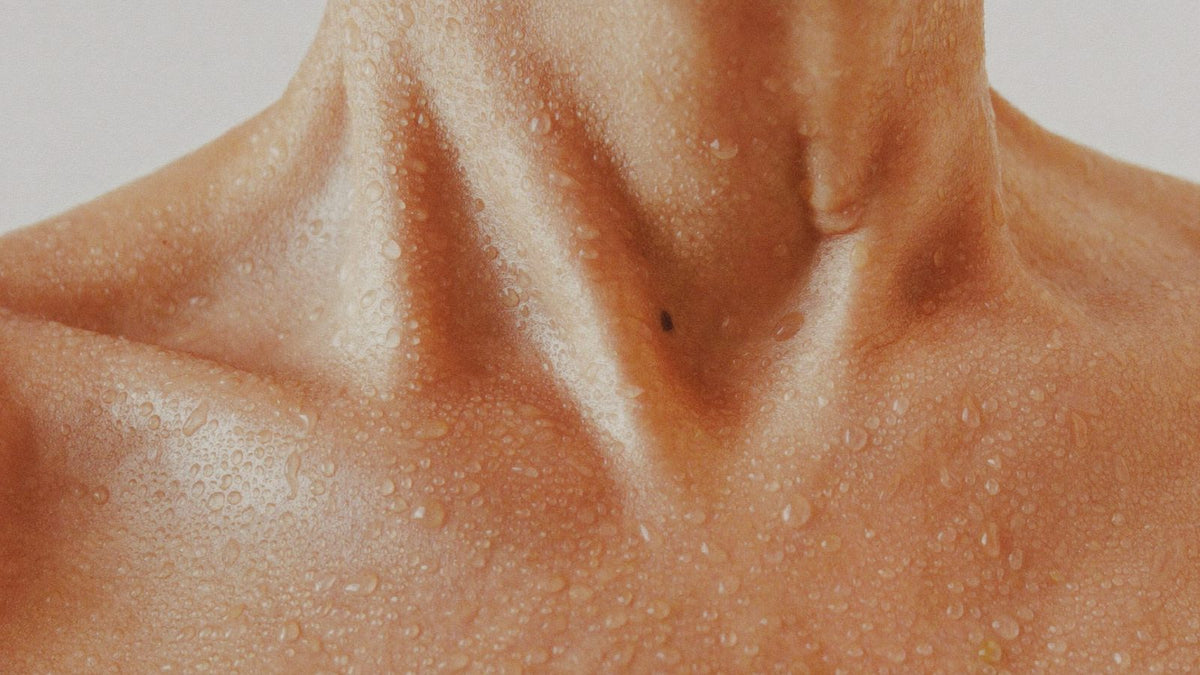
A 1987 biopsy study of postmenopausal women found that skin loses roughly 30% of its collagen in the first 5 years after menopause, then keeps declining by about 2% a year after that. That is not a slow fade. It is a structural drop, and it is the real reason skin on the arms, neck, and hands starts to look thin and crepey around the same years periods stop. Below is the research behind why that happens, what shilajit's own human skin study actually found, and where the evidence on fixing it currently stands.
Why does skin get crepey and saggy after menopause?

Crepey skin is not just thin skin. It is skin that has lost the dense, interwoven collagen and elastin scaffolding that normally holds it taut against gravity, leaving a surface that looks finely wrinkled, like crepe paper, and folds rather than springs back when pinched.
The landmark data on how much is lost, and when, comes from Brincat and colleagues, who biopsied the skin of untreated postmenopausal women and found collagen content fell fastest in the first 5 years after periods stopped. A separate study by Shuster and colleagues established the baseline most people never hear about, skin collagen already declines by roughly 1% a year starting in the twenties. That means the menopausal drop is not the beginning of skin aging. It is a sharp acceleration of something that had been happening slowly for decades.
The two proteins losing their biggest supporter
Two structural proteins do almost all of the work of keeping skin firm and bouncy:
- Collagen, mostly types I and III, forms the dense mesh that gives skin its tensile strength, the reason it does not tear or sag under normal stress
- Elastin, a separate protein, is what lets skin snap back into place after being stretched or pinched
- Collagen fibers get thinner and more disorganized as production slows, instead of running in the tight parallel bundles seen in younger skin
- Blood vessel density in the skin drops at the same time, which matters because fibroblasts, the cells that manufacture collagen, need a blood supply to do that work
- Fat and muscle beneath the skin also thin with age, removing the underlying support structure that used to hold the collagen layer taut
Every one of those changes points back to the same upstream signal. That signal is estrogen.
What does estrogen actually have to do with skin collagen?

Skin fibroblasts, the cells that build collagen, carry estrogen receptors directly on their surface. A 1999 study by Affinito and colleagues, comparing skin biopsies from premenopausal and postmenopausal women, concluded plainly that "the decrease of skin collagen is an estrogen-related phenomenon." That is not a hedge. It is the authors' own stated conclusion.
A 2013 review by Thornton laid out the mechanism in more detail, published in the journal Dermato-Endocrinology. The paper states plainly, "Estrogen insufficiency decreases defense against oxidative stress; skin becomes thinner with less collagen, decreased elasticity, increased wrinkling, increased dryness and reduced vascularity." That single sentence covers nearly every visible sign women report after menopause, in skin that has simply stopped getting the hormonal instruction to maintain itself at the same rate.
A 1994 study by Castelo-Branco and colleagues, biopsying 76 women's abdominal skin alongside their bone density, found something that rarely makes it into skincare marketing. Collagen loss in skin correlated with bone mass loss in the same women (r = 0.586, a strong statistical relationship). The authors were careful to say this does not prove osteoporosis is a collagen disorder, that remains unproven, but the finding shows the skin you see in the mirror and the bone density you cannot see are falling on a related timeline, in the same body, for a related reason. For more on that bone side specifically, see Optimum's shilajit osteoporosis clinical trial breakdown and the shilajit bone research hub.
None of this means nothing can be done. It means whatever is done has to work on the actual mechanism, not just the surface.
Has shilajit been tested on skin collagen in women?
Yes, in one real human trial, and the honest limits of that trial matter as much as the result. A 2019 randomized, placebo-controlled study led by Das and colleagues gave 45 women either a placebo or shilajit at 125 mg or 250 mg twice a day for 14 weeks, with skin biopsies taken at week 2 and week 14.
The findings were specific:
- At the 250 mg twice-daily dose, shilajit improved skin blood perfusion compared to both baseline and placebo, visible as increased reddish coloration on dermascopic imaging
- Three separate collagen genes were switched on at both doses tested: COL1A1, COL5A2, and COL14A1
- A set of genes tied to blood vessel growth and endothelial migration were also induced, through pathways called VEGFA and TGF-beta1
- The researchers' own stated conclusion was that "oral shilajit supplementation in adult healthy women induced genes relevant to endothelial cell migration and growth of blood vessels"
- No adverse effects were reported at 14 weeks
That trial is the basis of a real U.S. patent, number 11,077,045, granted in 2021 for using shilajit to improve skin microperfusion and switch on collagen-related genes.
What this study does and does not show
This is the section every skin claim about shilajit has to survive, honestly:
- The women in this trial had a mean age of 42 and the paper does not describe them as postmenopausal. It is a middle-aged women's study, not a postmenopausal one, and this article does not call it otherwise.
- The trial measured skin genes and blood flow, not wrinkle depth, firmness, or appearance. There is no before-and-after photo endpoint in this research at all.
- Elasticity, hydration, and water loss through the skin showed no difference between shilajit and placebo. That is a safety finding, not an efficacy win, and should never be read as the opposite.
- Only the higher, 250 mg twice-daily dose moved the blood flow measurement. The lower dose switched on the same genes without that effect.
A separate, earlier human trial by Das and colleagues in 2016 found something complementary in a different tissue. In 16 overweight adults taking shilajit for 8 weeks, muscle biopsies showed the gene for type I collagen running at roughly 86 times its baseline activity, alongside four other collagen types. Type I collagen is the same structural protein that makes up the bulk of skin's collagen network, so this is relevant systemic evidence of the body's collagen machinery responding to shilajit, even though that particular trial biopsied muscle tissue, not skin.
What does the research say about collagen supplements and creams?
The market for fixing collagen loss is enormous, and the evidence quality varies sharply by category. A fair side-by-side:
| Approach | What the research actually shows | Tested in postmenopausal skin specifically? |
|---|---|---|
| Topical retinoids | Multiple RCTs show measurable increases in collagen synthesis and reduced fine wrinkling over months of consistent use | Yes, in several dermatology trials |
| Oral collagen peptides | Several placebo-controlled trials show modest gains in elasticity and hydration, generally single-digit percentage improvements | Rarely isolates postmenopausal women as a subgroup |
| Topical vitamin C / antioxidant serums | Supports collagen synthesis as a required cofactor; does not independently drive new collagen production | No dedicated postmenopausal trials |
| Shilajit (oral) | One placebo-controlled trial found increased collagen gene activity and skin blood flow in middle-aged women; no appearance endpoint measured | No, trial population was not described as postmenopausal |
A scoop of collagen peptide is, chemically, building material. It gets broken down in digestion like any other protein and the body decides what to do with the amino acids. That is not a reason to call it useless, the peptide trials do show real, if modest, effects. It is a reason to separate "more raw material" from "a stronger signal to use it," which is a different question entirely.
What actually helps crepey skin, based on the evidence?
A few things have real research behind them, stated at the strength the evidence supports:
- Consistent sun protection slows further collagen breakdown; UV exposure is a separate, additive driver of collagen loss on top of the hormonal one
- Topical retinoids, used consistently over months, have the strongest dermatology-trial evidence for visibly increasing collagen synthesis
- Resistance exercise has been shown in some research to support skin thickness indirectly, likely through improved circulation and connective tissue loading
- Not smoking matters more than most people assume; smoking independently accelerates collagen breakdown through enzymes called matrix metalloproteinases
- Adequate protein intake supports the raw material fibroblasts need, even though it does not supply the signal to use it
None of these reverse the structural collagen loss documented above. They slow it, support it, or work alongside it.
Common questions
Is crepey skin reversible?
No published research shows a way to fully reverse the collagen architecture lost after menopause, and anyone promising that is overselling. What the research does show is that collagen production is not switched off permanently, it is running at a lower rate because the estrogen signal that drives it has fallen. Several interventions, including topical retinoids, certain peptides, and shilajit's own collagen-gene research, have been shown to raise collagen activity above that lowered baseline.
Does drinking more water help crepey skin?
Hydration affects skin plumpness in the short term, but crepey skin is a structural change in the collagen and elastin network underneath the surface, not a hydration problem. Dermatologists generally agree that no amount of water intake rebuilds a thinned collagen matrix.
Has shilajit been tested on wrinkles specifically?
No. The one placebo-controlled human skin trial on shilajit measured collagen gene activity and blood flow to the skin in middle-aged women, not wrinkle depth or appearance. This article states that limit clearly everywhere the study is discussed.
Why does skin on the arms and neck crepe before the face does?
Thinner skin with less underlying fat and muscle support shows collagen loss faster and more visibly. The backs of the hands, the upper arms, the neck, and the chest all have thinner dermis than the face, which is also why sun damage shows up there first.
Do collagen supplements actually rebuild skin?
Several placebo-controlled trials on oral collagen peptides show modest improvements in skin elasticity and hydration, generally in the range of a few percentage points over several months. That is a real, measured effect, but it is incremental, not a restoration of youthful skin, and most of those trials were not run in postmenopausal women specifically.

See Optimum Shilajit
Optimum Shilajit is built around the same collagen and estrogen-signaling research discussed in this article, including the placebo-controlled human skin study above. It has not been tested for wrinkle reduction or skin appearance, and this article makes no such claim. See Optimum Shilajit.
See See Optimum ShilajitSources
- Brincat M, Moniz CJ, Studd JW, et al. Decline in skin collagen content and metacarpal index after the menopause and its prevention with sex hormone replacement. Br J Obstet Gynaecol. 1987.
- Shuster S, Black MM, McVitie E. The influence of age and sex on skin thickness, skin collagen and density. Br J Dermatol. 1975. PMID 1220811.
- Affinito P, Palomba S, Sorrentino C, et al. Changes in menopausal skin collagen. Maturitas. 1999. PMID 10656502.
- Thornton MJ. Estrogens and aging skin. Dermatoendocrinol. 2013. PMID 24194966.
- Castelo-Branco C, Pons F, Gratacos E, et al. Relationship between skin collagen and bone changes during aging. Maturitas. 1994. PMID 8015503.
- Das A, Datta S, Rhea B, et al. The human skin proteome reveals effects of oral shilajit supplementation on a cohort of middle-aged women. J Am Coll Nutr. 2019. PMID 31161927.
- Das A, Datta S, Thannickal AJ, et al. Skeletal muscle gene expression changes in response to shilajit in young adults. J Med Food. 2016. PMID 27414521.
- Sen CK, Kalidindi SR. Blood microperfusion to skin by shilajit. U.S. Patent 11,077,045 B2. 2021.