
Statins and Cholesterol After Menopause: What the Shilajit Research Shows
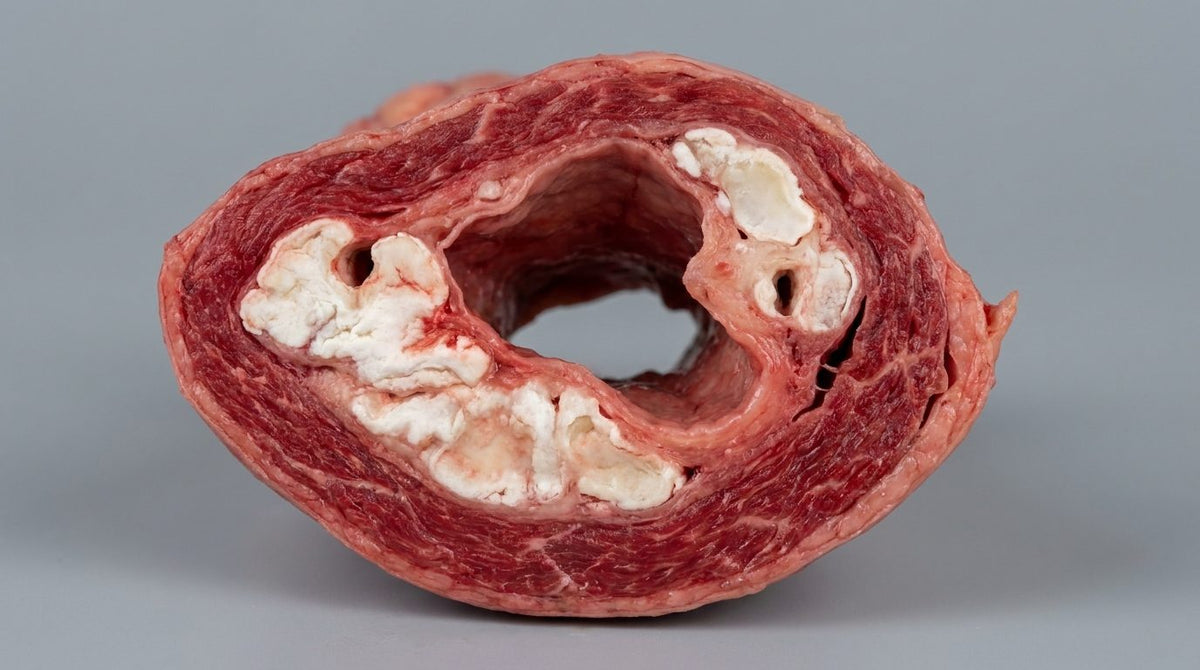
Cholesterol rising after menopause is rarely about diet. Estrogen spends decades quietly telling the liver how much cholesterol to produce and how much to clear, and when that signal fades, the number climbs even in women who eat well and exercise. A statin can force the number back down, but a Women's Health Initiative study following 161,808 postmenopausal women found statin use raised their risk of developing diabetes by 71 percent. Shilajit's own cholesterol trials measured a different route, one built around restoring the signal instead of overriding it.
Why does cholesterol rise after menopause even when nothing else changes?

Your liver makes most of the cholesterol in your body on its own, roughly 80 percent of it, and it uses that cholesterol as raw material for hormones, cell walls, and nerve coatings. Cholesterol itself is not the problem. What changes at menopause is who is managing it.
For most of your adult life, estrogen worked like a thermostat on your liver. It signaled how much cholesterol to synthesize and how much to clear through LDL receptors, keeping the whole system in a fairly narrow, healthy range without you ever thinking about it. When estrogen drops sharply at menopause, that regulating signal drops with it.
The thermostat that goes quiet
This is why so many women describe the same confusing pattern. They lost weight and their numbers did not move. They went vegan and their numbers did not move. They started running and their numbers did not move. None of those changes were wrong, they simply were not addressing the actual control system.
- Diet affects how much cholesterol you take in, not how your liver regulates what it makes
- Exercise improves overall cardiovascular fitness, but it does not restore a hormonal signaling pathway
- Weight loss can help modestly, but it does not replace estrogen's role in liver regulation
- None of these habits were ever positioned to be the thermostat, only to support it
What do statins actually do, and what do they take with them?

Statins work by blocking an enzyme in the liver called HMG-CoA reductase, which sits early in a chain of chemical reactions called the mevalonate pathway. Blocking that enzyme reduces how much cholesterol the liver produces. It is a real, well-documented, effective mechanism for lowering LDL.
The complication is that the same mevalonate pathway also produces coenzyme Q10, a compound your muscles and brain use to generate cellular energy. When a statin shuts down cholesterol production upstream, it can reduce CoQ10 production along the same route. Researchers have documented this connection for years as a leading explanation for statin-associated muscle pain and fatigue, two of the most commonly reported reasons women stop taking the medication.
The diabetes risk found specifically in postmenopausal women
The Women's Health Initiative, one of the largest long-running studies of postmenopausal women's health in the United States, produced a finding that rarely comes up at a routine cholesterol visit. Culver and colleagues tracked 161,808 postmenopausal women through 2005 and found statin users had a 71 percent higher risk of developing diabetes than non-users, a result that held up after adjusting for other health factors and applied across both high and low-potency statins.
- Muscle pain and weakness, often severe enough to stop exercise
- Fatigue that does not improve with rest
- Brain fog, sometimes described as "not feeling like myself"
- An elevated risk of developing diabetes, confirmed in a 161,808-woman cohort
None of this means a statin is the wrong choice for every woman. It means the drug is treating the downstream number without addressing the upstream signal, which is exactly the gap shilajit's own research was tested against.
What does shilajit's own cholesterol research show?

Shilajit is a mineral resin, rich in fulvic acid, that forms over centuries in the Altai mountains. Two separate human trials have measured its effect on cholesterol directly, and neither one used a statin's mechanism to get there.
Niranjan and colleagues ran a 12-week randomized controlled trial in 40 people with type 2 diabetes. LDL fell 13 percent. Total cholesterol fell 21 percent. Triglycerides fell 16 percent. HDL, the cholesterol your body wants more of, rose 14 percent. The same trial also found reduced hsCRP and MDA, two markers of inflammation and oxidative stress, along with improved endothelial function. A separate 45-day open-label study by Sharma and colleagues in healthy adults found stable blood pressure and pulse alongside reduced triglycerides and total cholesterol, increased HDL, and improved antioxidant status.
| What a statin does | What shilajit's trials measured | |
|---|---|---|
| Mechanism | Blocks an enzyme in the liver's cholesterol-production pathway | Supports the body's own estrogen signaling and antioxidant activity |
| LDL | Typically lowers LDL 20 to 50 percent, depending on dose | Lowered LDL 13 percent in a 12-week RCT |
| CoQ10 | Can reduce CoQ10 along the same blocked pathway | Preserved CoQ10 in animal research (below) |
| Diabetes risk | Raised risk 71 percent in a 161,808-woman cohort | No diabetes-risk increase reported in either trial |
These are two different tools measured two different ways, and this article is not suggesting they produce identical results. A 13 percent LDL reduction is not the same as a 40 percent one. What the shilajit trials demonstrate is a route to real, measurable lipid improvement that did not come from shutting the liver's production line down by force.
Can shilajit protect the CoQ10 that statins drain?

Here the honest limits of the research matter as much as the finding itself. Bhattacharyya and colleagues tested shilajit's fulvic-acid-derived compounds in a rat model and found they preserved CoQ10 levels in heart and liver tissue. That is real, peer-reviewed, published evidence of a protective mechanism.
It is an animal study, not a human trial, and no research has tested shilajit alongside a statin in a person. This article states that plainly rather than implying more than the evidence supports.
What CoQ10 actually does, for context:
- Powers the mitochondria inside nearly every cell, especially in muscle and heart tissue
- Supports the energy production your brain draws on for focus and clarity
- Naturally declines somewhat with age, independent of any medication
- Is the specific compound multiple statin studies have linked to the drug's most common side effects
The mechanism connecting fulvic acid to CoQ10 preservation is genuinely interesting, and it is exactly the kind of animal-model groundwork that eventually leads to a human trial. It has not gotten there yet, and this article will not pretend otherwise.
Is shilajit safe if you're worried about estrogen and breast cancer?
For a woman with a family history of breast cancer, any conversation about estrogen signaling raises the same question immediately, and it deserves a direct answer. Shilajit is not a hormone. It adds no estrogen and blocks none. It supports the body's own estrogen signaling rather than replacing it, which is a meaningfully different mechanism than hormone replacement therapy.
A laboratory study tested shilajit directly against MCF-7 cells, the most widely used estrogen-receptor-positive breast cancer cell line in research, the same type frequently discussed in family cancer histories. The study found shilajit worked against the cancer cells in culture while leaving healthy breast cells unharmed.
What to look for in a shilajit product
Not every product on the shelf reflects what the research actually used, and the difference matters.
- Purified resin, not raw powder. Powder form loses much of its fulvic acid during processing.
- A real fulvic acid percentage, verified by an independent lab. Optimum tests every batch at 78 percent fulvic acid.
- Third-party testing for heavy metals, since low-grade resin sourced from contaminated soil can carry lead and arsenic.
- A clear country of origin. Optimum sources its resin from the Altai mountains, cold pressed with zero heat processing.
Across every human clinical study conducted on shilajit, zero serious adverse events have been reported. Optimum is a small, family owned company out of Florida, and it ships as a box of tablets, never a loose powder that degrades before it reaches you.
A specific cholesterol history, current statin dose, or personal cancer history is exactly the kind of individual detail a general safety record cannot substitute for. This article is educational, describing what the published research measured, not medical guidance for your own situation.
Common questions about statins, cholesterol, and shilajit after menopause
Why did my cholesterol go up if my diet and exercise haven't changed?
Estrogen helps the liver regulate how much cholesterol it makes and clears. When estrogen drops at menopause, that regulation loosens even when diet and exercise stay exactly the same, which is why a woman who has not changed a single habit can still see her numbers climb.
Do statins fix the reason cholesterol went up?
No. Statins block an enzyme in the liver called HMG-CoA reductase, which lowers cholesterol production directly, but they do not restore the estrogen signaling that was regulating it in the first place. That is why cholesterol tends to climb back once a statin is stopped.
Does shilajit lower cholesterol as much as a statin?
No published shilajit trial has been run head to head against a statin, and this article does not claim equivalence. A 12-week randomized trial found shilajit lowered LDL 13 percent and total cholesterol 21 percent in people with type 2 diabetes, a meaningful result on its own terms, not a substitute claim for statin-level LDL reduction.
Is the CoQ10 research on shilajit done in humans?
No, and this article says so plainly. The CoQ10 preservation finding comes from a rat study of heart and liver tissue. It is real, published, peer-reviewed evidence of a mechanism, not a human clinical result, and the two should not be confused.
Is shilajit safe to take if I'm worried about breast cancer and estrogen?
Shilajit is not a hormone. It does not add estrogen or block it, it supports the body's own estrogen signaling. A laboratory study tested shilajit directly on MCF-7 cells, the most common estrogen-receptor-positive breast cancer cell line used in research, and found it worked against the cancer cells while leaving healthy cells unharmed.

Optimum Shilajit Trifecta
If you want the fulvic acid and trace minerals behind the cholesterol research above, alongside the two other ingredients in Optimum's bone and metabolic formula, here is .
See Optimum Shilajit TrifectaSources
- Culver AL, Ockene IS, Balasubramanian R, et al. Statin use and risk of diabetes mellitus in postmenopausal women in the Women's Health Initiative. Archives of Internal Medicine. 2012;172(2):144-152. https://pubmed.ncbi.nlm.nih.gov/22231607/
- Niranjan Reddy PB, et al. Efficacy and safety of purified Shilajit on cardiovascular risk markers in type 2 diabetes. International Journal of Ayurveda and Pharma Research. 2016. https://ijapr.in/index.php/ijapr/article/view/322
- Sharma P, et al. Effect of Shilajit on blood chemistry in healthy human subjects. Ancient Science of Life. 2003. https://pubmed.ncbi.nlm.nih.gov/22557121/
- Bhattacharyya S, et al. Shilajit dibenzo-alpha-pyrones preserve coenzyme Q10 in rat heart and liver tissue. 2009.
- MCF-7 estrogen-receptor-positive breast cancer cell study on fulvic acid / shilajit compounds.