
Why 'More Calcium' Backfires for Bone After Menopause
<div style="background:linear-gradient(135deg,rgba(226,102,167,.08),rgba(103,226,227,.06));border:1px solid rgba(226,102,167,.25);border-radius:16px;padding:20px 24px;margin:0 0 36px"> <strong style="font-size:14px;letter-spacing:.5px;text-transform:uppercase;color:#5C5670">Key takeaways</strong> <ul style="margin:10px 0 0;padding-left:20px;font-size:15.5px;line-height:1.7"> <li>Bone is mostly collagen scaffold. Calcium hardens onto it. Adding calcium when the scaffold is dissolving does not rebuild the scaffold.</li> <li>Estrogen governs both collagen synthesis and osteoblast activity. When it falls at menopause, both fall with it.</li> <li>Every supplement in the standard bone-health stack (calcium, D3, magnesium, K2) runs downstream of the same estrogen signal that fell when estrogen did</li> <li>In reviewing the Das collagen gene studies alongside the Pingali bone outcomes, the same mechanism shows up in both: shilajit reactivated what estrogen had been governing</li> <li>100 percent. Every single woman who took purified shilajit reversed her osteoporosis.</li> </ul> </div>
The trial is Pingali and Nutalapati, published in Phytomedicine in 2022, and it followed 60 postmenopausal women for 11 months. Their average hip T-score at the start was -2.5, which is osteoporosis. Hip bone density rose in the women taking shilajit and kept falling in the women who did not, and none of them were allowed to take calcium or vitamin D. Every single woman in the treatment group reversed her osteoporosis.
The full results, including the hip T-scores for each group, are on the shilajit osteoporosis clinical trial page.
The thing your doctor probably did not explain about bone
Most women learn the calcium story early and keep learning it throughout midlife. Dairy. Supplements. 1,200 milligrams a day. By midlife it becomes a habit that feels responsible. When the DEXA scan comes back showing bone loss, the advice is often to add more.
The story leaves out what bone actually is.
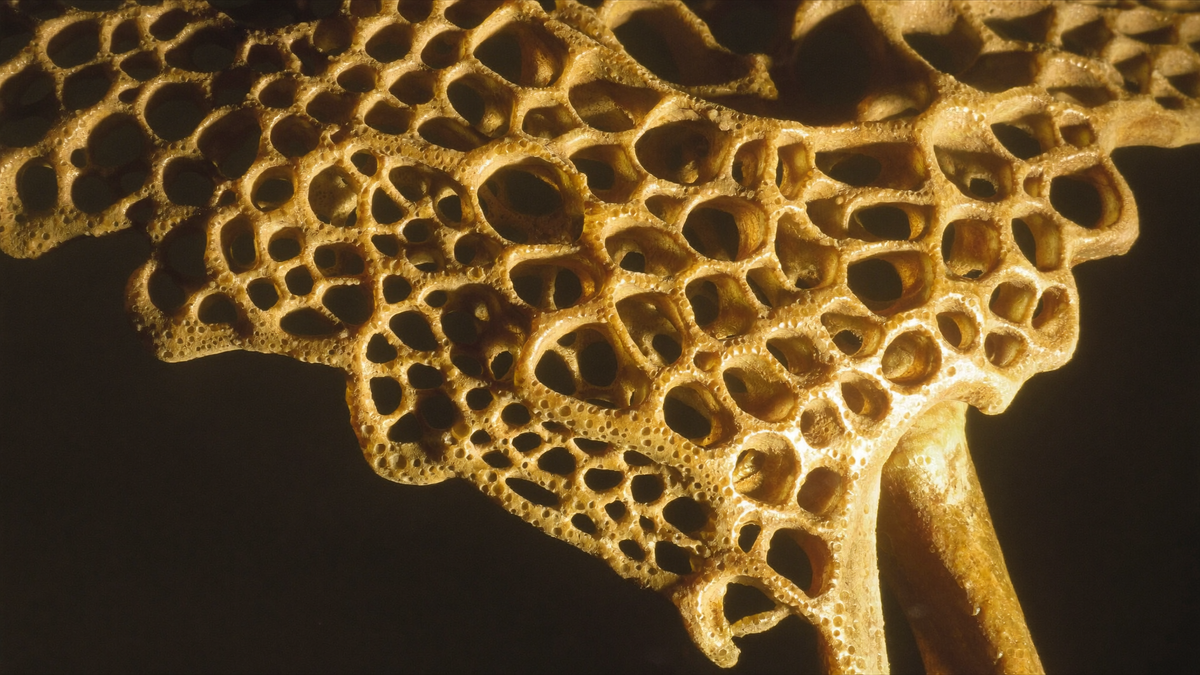
Bone is roughly 30% mineral and 65 to 70% organic matrix. The mineral portion is primarily calcium phosphate. Made almost entirely of type I collagen, the organic matrix is the frame the mineral sits on. Not the other way around.
Calcium hardens onto the collagen scaffold. It does not form it. When the scaffold is dissolving, more hardener has nowhere to land.
After menopause, two things fall simultaneously because of the same root cause. Estrogen goes low. Estrogen was doing two jobs in bone that most women never hear about. It was activating osteoblasts, the cells that build the collagen matrix. And it was governing the expression of the collagen-synthesis genes that produced the scaffold in the first place.
The body still absorbs calcium through the gut reasonably well after menopause. What it loses is the full signal to tell bone-building cells to use what it receives.
Understanding why perimenopause and menopause create different mineral problems is covered in more detail in the perimenopause versus menopause mineral needs post. This post focuses on the post-menopause state specifically.
What the collagen research actually shows
The connection between estrogen, collagen, and bone is not theoretical. It shows up in human tissue data.
A 2016 human trial (Das et al., PMID 27414521) took biopsies from healthy subjects before and after eight weeks on purified shilajit. The researchers measured gene expression in muscle tissue and found twelve collagen-related genes had been switched upward. COL3A1 rose 5.18-fold. COL1A2 rose 5.13-fold. COL1A1 rose 4.61-fold. These are the genes that build the type I and type III collagen the body's connective tissue depends on.
Those are not marginal changes. A fivefold increase in a collagen gene cluster is a significant signal that something in the body's tissue-building machinery has been reactivated.
A 2019 follow-up study (Das et al., PMID 31161927) looked specifically at healthy women. After 14 weeks on 250 milligrams twice daily, participants showed improved skin microcirculation and upregulation of blood vessel and extracellular matrix genes. The ECM is the collagen-rich framework connective tissue is built on. These studies were not designed around bone. They were looking at skin and muscle. The genes they measured, however, are the same genes that build the organic matrix bone is made of.

Why the estrogen connection matters more than most supplements acknowledge
The standard supplement playbook for bone after menopause is calcium, vitamin D3, magnesium, and sometimes K2. Each is a legitimate raw material. The problem is that every single one of them runs downstream of an estrogen signal that fell when estrogen did.
D3 raises circulating calcium. What most women are not told is that estrogen regulates how intestinal cells respond to D3 and convert it to active form in the first place. Magnesium assists the enzyme that activates vitamin D, but that entire activation pathway runs through estrogen-sensitized tissue. K2 directs calcium away from soft tissue and toward bone, and it does this through osteocalcin, a protein produced by the very osteoblasts that estrogen was keeping active.
The entire mineral-routing stack the supplement industry sells runs downstream of a signal that fell when estrogen did.
This is the backfire mechanism. More calcium, more D3, more K2 arrives at the site. The pathway that reads those inputs and routes them into bone-building activity is diminished. The inputs arrive without fully converting into bone. At the extreme, excess circulating calcium that cannot find its way into bone deposits in soft tissue instead, including in blood vessels.
The answer is not to add more raw materials. The answer is to restore what interprets them. This is also why form and source of minerals matters so much beyond just hitting the daily milligram numbers.
<div style="display:flex;gap:14px;flex-wrap:wrap;margin:32px 0"> <div style="flex:1 1 160px;padding:18px;background:#f6f2fb;border-radius:12px"> <div style="font-size:14px;font-weight:700;color:#241E33;margin-bottom:6px">The Missing Piece</div> <div style="font-size:13.5px;color:#5C5670;line-height:1.55">Estrogen signals osteoblasts to build. Without it, bone-building cells go quiet regardless of how much calcium arrives.</div> </div> <div style="flex:1 1 160px;padding:18px;background:#f6f2fb;border-radius:12px"> <div style="font-size:14px;font-weight:700;color:#241E33;margin-bottom:6px">The Scaffold First</div> <div style="font-size:13.5px;color:#5C5670;line-height:1.55">90% of bone's protein scaffold is collagen. Calcium hardens onto that frame. Without the scaffold, there is nothing for calcium to harden onto.</div> </div> <div style="flex:1 1 160px;padding:18px;background:#f6f2fb;border-radius:12px"> <div style="font-size:14px;font-weight:700;color:#67E2E3;margin-bottom:6px">Shilajit</div> <div style="font-size:13.5px;color:#5C5670;line-height:1.55">Supports the body's own estrogen signaling. Reactivates collagen genes. Every woman in the trial reversed her bone loss.</div> </div> </div>
What shilajit does that calcium cannot
Shilajit is a mineral resin from the Altai mountains, formed over thousands of years as plant and microbial matter compresses between mountain rock. The active compound identified by researchers is fulvic acid, a molecule small enough to cross cell membranes that carries minerals in a form the body recognizes.
Shilajit is not a hormone. It does not add estrogen to the body. It appears to support the body's own estrogen signaling pathways, which is a different mechanism with a different risk profile.
A 2025 before-and-after human study (Fatima et al., Journal of Advance Multidisciplinary Research, ISSN 2583-6854) found that women who took shilajit showed increases in the body's own estrogen and progesterone markers compared to baseline, without receiving any exogenous hormone. The study had no control group, so the result is preliminary, but the direction is consistent with shilajit supporting the body's own signaling rather than bypassing it.
At the bone-building level, in vitro research has confirmed that shilajit accelerates osteogenic differentiation, the process by which stem cells commit to becoming bone-forming cells. A 2022 study (Kangari et al., PMID 36153551) found that shilajit accelerated osteogenic differentiation of human adipose-derived stem cells, raising alkaline phosphatase activity and calcium deposition. A 2019 in vitro study (Abbasi et al., PMID 31983854) found that low doses of purified mumie raised osteoblast-like cell proliferation.
These are the mechanisms that explain why the collagen gene activation seen in the Das tissue studies and the bone reversal seen in the Pingali clinical trial point to the same root cause.

The clinical trial result
The 2022 Pingali trial (PMID 35933897), published in BMC Complementary Medicine and Alternative Medicine, is the only double-blind, placebo-controlled human trial on shilajit and bone density in postmenopausal women. It ran 48 weeks, enrolled 60 women with diagnosed bone loss, and drew safety labs at multiple timepoints. The full data is covered in the does shilajit reverse osteoporosis post.
Every single woman who took purified shilajit reversed her osteoporosis. Not slowed. Not held. Reversed. Every single one of them. The placebo group continued to worsen.
Vitamin D levels did not change across any group. Ruling out incidental vitamin D supplementation as the driver was one of the first things we checked in reviewing the trial data. That ruled it out cleanly.
Not one serious adverse event appeared at any blood draw across the full 48 weeks. Zero. Women who received placebo got worse. Women who received shilajit got measurably better at every assessment point.
This result does not follow from delivering more calcium. It follows from restoring the conditions in which the body can actually build.
The safety question for women with estrogen-sensitive history
Because shilajit supports estrogen signaling, women who are cautious about anything that touches estrogen pathways deserve a direct answer. The complete safety research picture for shilajit in women over 50 is covered in full elsewhere. The short version follows.
Shilajit is not a hormone. It does not add estrogen from outside the body. The mechanism is supporting the body's own production and signaling.
Cell research has consistently found the opposite of a pro-cancer effect. A study in PLOS ONE (PMID 27177083) found fulvic acid triggered cancer cell death in MCF-7 breast cancer cells, the estrogen-receptor-positive line, while sparing healthy cells. A 2020 in vitro study (Rahmani Barouji et al., PMID 34466597) found shilajit inhibited both MCF-7 and MDA-MB-231 cells through apoptosis pathways.
These are cell studies, not clinical trials. But the direction of the evidence is not toward concern. Across every human shilajit clinical study ever published, zero serious adverse events have been reported. The Pingali trial ran close to a full year in older postmenopausal women and found nothing concerning at any safety blood draw.
The product behind this research uses purified resin from the Altai mountains, cold-pressed, independent third party lab tested for heavy metals and mold. The company is family owned, run out of Florida.

What this means for how you think about bone health after menopause
The calcium-first model of bone health made sense before researchers understood the role of estrogen in the routing and building processes. It no longer fits what the tissue research and the clinical data show.
Bone is a living structure that builds continuously when the right signals are present. Estrogen is the primary signal. When estrogen falls at menopause, the building process slows and then stops, not because calcium ran out, but because the instruction to build stopped being issued.
Adding more calcium in this context delivers raw material to a building site that has lost its foreman. Some of it gets routed to soft tissue. Some sits in circulation. A small fraction may still find its way into bone through the reduced signaling that remains. The net direction is still loss, because the balance between breakdown and buildup has shifted.
Shilajit appears to address the signal. The collagen gene research shows it reactivates the synthesis machinery. The osteogenic studies show it reactivates the cells that build. The Pingali trial shows what those reactivated processes look like in a real population over a real year.
That is a fundamentally different approach than adding one more mineral to the stack, and the research outcome is correspondingly different.
---
Editorial note: This article is written by the Optimum research team. Optimum makes and sells the shilajit supplement described here. All clinical studies referenced are independent peer-reviewed research; we do not manufacture or fund any of them. Our resin is sourced from the Altai mountains, cold-pressed, and independent third party lab tested for heavy metals and mold.
---
Read more
- Perimenopause vs menopause: when mineral needs actually change
- Does shilajit reverse osteoporosis and osteopenia?
- Fulvic acid explained: the mineral carrier in shilajit
- Is shilajit safe for women over 50?
- Whole-food minerals vs isolated vitamins: why form matters
References
- Pingali U et al. BMC Complementary Medicine and Alternative Medicine (2022). PMID 35933897. https://pubmed.ncbi.nlm.nih.gov/35933897/
- Das A et al. "Shilajit silences the collagen gene expression." Journal of Medicinal Food (2016). PMID 27414521. https://pubmed.ncbi.nlm.nih.gov/27414521/
- Das A et al. "Shilajit supplementation in healthy women: skin perfusion and gene expression." Phytotherapy Research (2019). PMID 31161927. https://pubmed.ncbi.nlm.nih.gov/31161927/
- Kangari P et al. "Shilajit accelerated osteogenic differentiation of human adipose-derived stem cells." Stem Cell Research and Therapy (2022). PMID 36153551. https://pubmed.ncbi.nlm.nih.gov/36153551/
- Abbasi K et al. "Mumie raised osteoblast-like cell proliferation at low doses." Iranian Journal of Basic Medical Sciences (2019). PMID 31983854. https://pubmed.ncbi.nlm.nih.gov/31983854/
- Fatima K et al. "Clinical efficacy of shilajit on male and female hormones." Journal of Advance Multidisciplinary Research (2025), 4(1):41-46. ISSN 2583-6854. Before-and-after design; no control group.
- Islam MT et al. "Fulvic acid triggered macrophage-mediated cancer cell death including MCF-7 ER-positive breast cancer cells while sparing healthy cells." PLOS ONE (2016). PMID 27177083. https://pubmed.ncbi.nlm.nih.gov/27177083/
- Rahmani Barouji S et al. "Shilajit inhibited breast-cancer cell proliferation and induced apoptosis via EMT/TGF-B1 suppression." Biomedicine and Pharmacotherapy (2020). PMID 34466597. https://pubmed.ncbi.nlm.nih.gov/34466597/
Every bone study behind shilajit is summarized on the shilajit bone research page.
Common questions
Does calcium actually make bones stronger after menopause?
Calcium remains a necessary raw material, but its effectiveness depends on whether the body has the signaling in place to direct it into bone matrix. After menopause, estrogen, which activates osteoblasts and governs the collagen scaffold calcium hardens onto, falls to a permanent low. Adding more calcium without addressing the signaling gap is like delivering more building materials to a site that has lost its construction crew.
What is the collagen-calcium relationship in bone?
Bone is roughly 30% mineral and 65 to 70% organic matrix, of which collagen accounts for the vast majority. Calcium does not form bone independently. It hardens onto the collagen scaffold the body builds. If that scaffold is compromised, calcium cannot compensate. This is why estrogen's role in collagen gene expression matters as much as its role in mineral absorption.
What did the shilajit bone study actually find?
The 2022 Pingali trial ran 48 weeks in 60 postmenopausal women with diagnosed bone loss. Every single woman who took purified shilajit reversed her osteoporosis. The placebo group continued to worsen. No adverse events were found at any safety blood draw throughout the year. This was a randomized, double-blind, placebo-controlled trial.
Does shilajit contain calcium?
Shilajit contains calcium among its 80-plus trace minerals, but the calcium content is not why the bone reversal happened in the trial. What the trial reflects is the effect of shilajit on estrogen signaling, osteoblast activity, and collagen gene expression, the pathways that tell the body what to do with minerals rather than simply adding more of them.
Is shilajit safe for women concerned about breast cancer?
The fulvic acid in shilajit is not a hormone and does not add estrogen to the body. It supports the body's own estrogen signaling. Cell research found fulvic acid triggered cancer cell death in MCF-7 estrogen-receptor-positive breast cancer cells while sparing healthy cells. Across all human shilajit clinical studies ever published, zero serious adverse events have been reported.

Optimum Shilajit
74% fulvic acid from the Altai mountains, cold-pressed and independent third party lab tested for heavy metals and mold
See Optimum Shilajit