
Osteopenia vs Osteoporosis: What the Difference Means for You
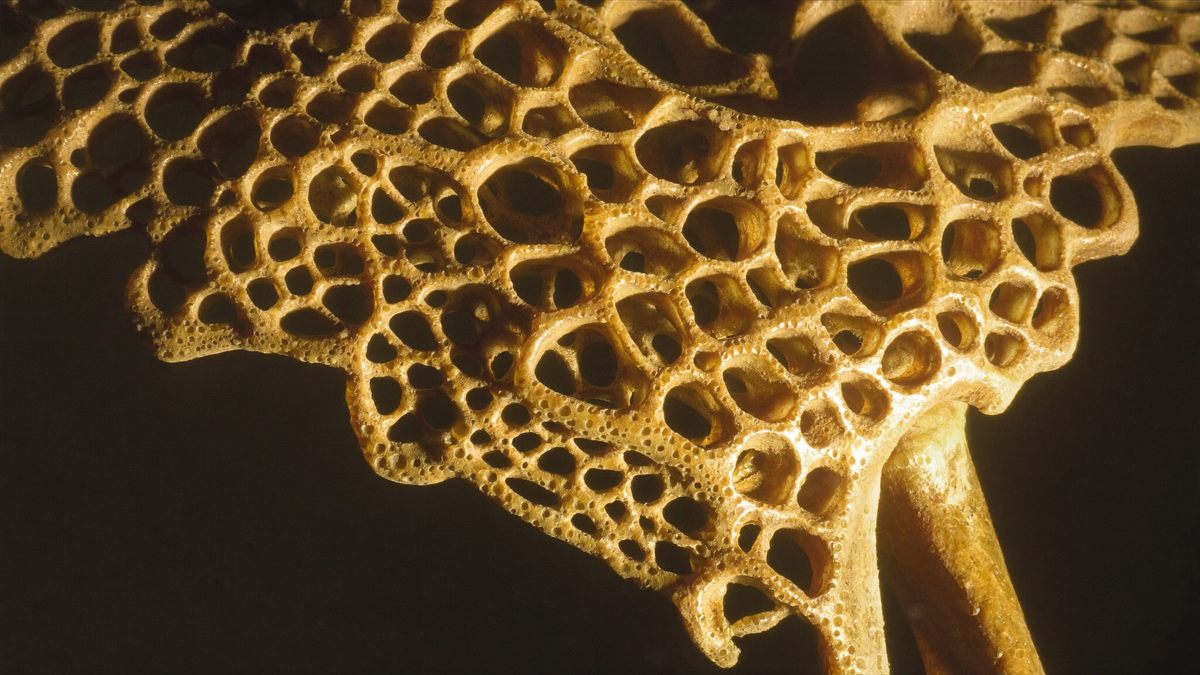
Osteopenia and osteoporosis are the same process at two stages. Both describe bone that has lost some mineral density, measured on a bone-density scan as a T-score. Osteopenia is the earlier, milder stage. Osteoporosis is the more advanced stage, where bone is more porous and fractures more easily. The encouraging part is that bone is living tissue, rebuilt throughout life from collagen and minerals, so what you feed it every day genuinely matters.
What is the difference between osteopenia and osteoporosis?
The difference is degree, set by a single number from a bone-density scan called the T-score.

A DEXA scan compares your bone density to that of a healthy young adult and reports the gap as a T-score. The lower the number goes, the more mineral and structure the bone has lost.
| Result | T-score | What it means |
|---|---|---|
| Normal | -1.0 and above | Bone density in the healthy range |
| Osteopenia | Between -1.0 and -2.5 | Below-average density, early loss |
| Osteoporosis | -2.5 and below | Lower density, higher fracture risk |
So osteopenia is the early warning, not a verdict. It is the stage where everyday habits have the most room to work, which is exactly why understanding it is worth your time.
Why does bone loss speed up after menopause?
Bone is always being broken down and rebuilt at the same time. After menopause, the rebuilding side slows while the breakdown side keeps pace, so density can fall faster in those first years.
Through your whole life, special cells dissolve small patches of old bone and others lay down fresh bone in their place. When the body's renewal signals weaken after menopause, that balance tips toward removal, and the scale can tilt for a few years before it settles.
This is also when the raw materials matter more. The body needs steady protein for the collagen scaffold and a spread of minerals to harden it, at the very moment it is working harder to keep up. That is the practical reason daily inputs start to count for more after 50.
Can you rebuild bone, or only slow the loss?
Bone is living tissue that renews throughout life, so the goal is not only to slow loss but to keep active rebuilding well fed.
The strongest trial in this area is encouraging on exactly that point. Pingali and colleagues (2022), published in Phytomedicine, followed 60 postmenopausal women with osteopenia for 48 weeks in a double-blind, placebo-controlled design.
Every single woman reversed her osteopenia within 24 weeks. Bone density was preserved dose-dependently, and the study recorded zero side effects. For a stage that often gets framed as a slow slide, that is a genuinely hopeful result from a well-run trial.
Beyond calcium: what is bone actually made of?
Bone is not a solid block of calcium. It is a living scaffold of collagen protein, hardened by calcium, magnesium, silicon, and other trace minerals.

A useful picture is reinforced concrete. The collagen is the flexible steel rebar that gives bone the ability to bend a little under load without snapping. The minerals are the concrete poured around it for hardness. You need both, working together, for bone that is strong and not brittle.
This is why a single mineral is rarely the whole story. Calcium without the collagen scaffold, and without the trace minerals that help organize it, is concrete with no rebar inside.
The same scaffold shows up across the body, which is the whole-body thread here. When Das and colleagues (2019) gave shilajit to middle-aged women for 14 weeks, their skin switched on the genes that build collagen and new blood vessels, and the earlier muscle work from Das (2016) saw the same collagen genes run several times higher than normal. Silicon, one of the trace minerals in the Altai complex, is part of how that collagen network cross-links and holds its shape.
What does the research show about shilajit and bone?
Shilajit's bone evidence runs from a human trial all the way down to the cell, and the threads point the same direction.

Beyond Pingali's human trial, a separate double-blind study (Sadeghi and colleagues, 2020, with 160 participants) found that oral shilajit shortened the average tibial-fracture healing time by around 24 days versus placebo. Faster healing of a real break is a meaningful signal that the material is helping bone do its job.
In the laboratory, shilajit pushes bone-building cells to mature faster. Kangari and colleagues (2022) watched it speed the osteogenic development of human stem cells, raising the markers of active bone formation, and Abbasi and colleagues (2019) saw low-dose mumie lift the activity of osteoblast-like cells.
Underneath all of it is the mineral-delivery chemistry. Fulvic acid, the most-studied compound in shilajit, binds trace mineral ions and carries them into cells in a form the body recognizes, the same way minerals reach your cells from whole food. The human trials are still catching up to chemistry we already understand well, and the direction they point is consistent.
What can you do day to day?
Bone responds to steady inputs, not heroics. A few habits, repeated, do more than any single big effort.

- Weight-bearing movement, like walking or light resistance work, signals bone to hold its density.
- Protein at each meal, to supply the collagen scaffold bone is built on.
- A spread of minerals, not calcium alone: magnesium, silicon, zinc, and the trace elements that organize the matrix.
- Vitamin D and vitamin K2, from food and a little sun, which help route calcium into bone rather than soft tissue.
- A daily mineral complex like shilajit, to cover the wide trace-mineral base a modern diet often misses.
For shilajit specifically, the simple habit is two tablets with breakfast, since the minerals absorb better alongside food. And the reassurance behind it is the safety record: zero serious adverse events have ever been reported across any human shilajit study.
Common questions about osteopenia and osteoporosis
What T-score means osteopenia, and what means osteoporosis?
A T-score between -1.0 and -2.5 is classed as osteopenia, the early stage of below-average bone density. A T-score of -2.5 or lower is classed as osteoporosis, where bone is more porous and fractures more easily. A score of -1.0 or above sits in the normal range.
Is osteopenia reversible?
Bone is living tissue that is rebuilt throughout life, so osteopenia is a stage you can act on rather than a fixed sentence. In a 48-week trial, Pingali and colleagues (2022) reported that every single woman in the treatment group reversed her osteopenia within 24 weeks. Day-to-day movement, protein, and minerals matter most at this stage.
What can shilajit do for bone?
Shilajit is a food-derived mineral complex, not a medicine. The published research is encouraging, and it works by delivering trace minerals in a form the body recognizes and supporting the collagen scaffold that bone is built from. Pingali (2022) studied it specifically in postmenopausal women with osteopenia.
Is shilajit safe to take every day?
Yes. Zero serious adverse events have ever been reported across any human shilajit study. At the recommended dose of two tablets with breakfast from a purified, third-party-tested source, daily use is exactly how it is meant to be taken.
Can I take shilajit alongside calcium and vitamin D?
Yes. Shilajit covers the wide trace-mineral base, while calcium, vitamin D, and vitamin K2 each play their own role in bone. They work on different parts of the same scaffold, so they complement each other rather than compete.
Pure Altai shilajit, tested in full
Sourced from the Altai mountains, purified, and pressed into tablets. Tested for all four heavy metals by a US-accredited laboratory, with every result published before you buy. Family-owned, out of Florida.
See Pure ShilajitSources
- Pingali U, Nutalapati C. "Shilajit extract reduces oxidative stress, inflammation, and bone loss to dose-dependently preserve bone mineral density in postmenopausal women with osteopenia: a randomized, double-blind, placebo-controlled trial." Phytomedicine. 2022;105:154334. PMID 35933897
- Sadeghi SMH, et al. "The effect of momiai (mumijo) on tibial fracture healing: a randomized, double-blind, placebo-controlled trial." 2020. PMID 32310691
- Kangari P, et al. "Shilajit accelerates the osteogenic differentiation of human adipose-derived stem cells." 2022. PMID 36153551
- Abbasi MM, et al. "Effect of mumie on proliferation of osteoblast-like cells in vitro." 2019. PMID 31983854
- Das A, et al. "Skin Transcriptome of Middle-Aged Women Supplemented With Natural Herbo-mineral Shilajit Shows Induction of Microvascular and Extracellular Matrix Mechanisms." 2019. PMID 31161927
- Das A, et al. "The Human Skeletal Muscle Transcriptome in Response to Oral Shilajit Supplementation." J Med Food. 2016;19(7):701-709. PMID 27414521
- Jugdaohsingh R. "Silicon and bone health." J Nutr Health Aging. 2007;11(2):99-110.
- Stohs SJ. "Safety and efficacy of shilajit (mumie, moomiyo)." Phytother Res. 2014;28(4):475-479. PMID 23733436