
Can You Rebuild Bone After 50, or Only Slow the Loss?
You can do more than slow the loss. Bone is living tissue that tears itself down and rebuilds throughout your whole life, including well past 50. In a 48-week placebo-controlled trial of postmenopausal women with osteopenia, Pingali (2022) found every single woman in the treatment group reversed her osteopenia within 24 weeks. Rebuilding is real, it is just slow, and it asks for more than a calcium pill: the collagen scaffold bone is built on, a full spread of trace minerals, and the cellular energy to do the work.
Is bone actually alive, or just a fixed frame?
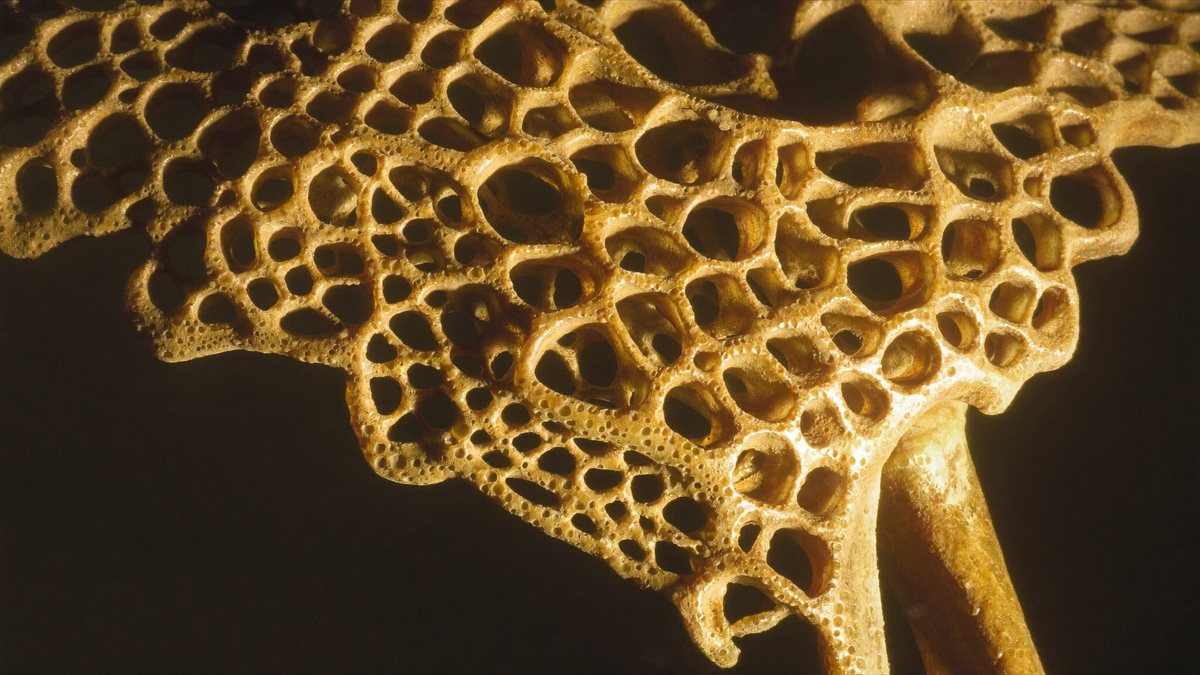
Bone is alive, and it is busy. It is not the dry, finished thing you picture in a museum. It is a living tissue with its own blood supply, rebuilt piece by piece your entire life.
Two crews run the job. Cells called osteoclasts dissolve old, worn bone and carry it away. Cells called osteoblasts move in behind them and lay down fresh bone in its place. This constant teardown-and-rebuild is called remodeling, and it never stops.
The whole adult skeleton turns over roughly every ten years. So the bone you have at 60 is not the bone you had at 50. It is newer tissue, made by cells that were doing their work the entire time. That single fact is why the question has a hopeful answer.
Can you rebuild bone after 50, or only slow the loss?
You can shift the balance back toward building, not only apply the brakes. The strongest evidence in the whole field says so plainly.

Pingali and colleagues (2022), published in Phytomedicine, followed 60 postmenopausal women with osteopenia for 48 weeks in a randomized, double-blind, placebo-controlled trial. Every single woman in the treatment group reversed her osteopenia within 24 weeks. Bone mineral density was preserved dose-dependently, and the study recorded zero side effects.
That trial does not stand alone. The supporting evidence lines up behind it from several directions:
- Fracture healing. Sadeghi and colleagues (2020) ran a double-blind trial in 160 people and found oral shilajit cut average tibial-fracture healing time to 129 days versus 153 days on placebo, around 24 days faster. Faster repair means the building crew is working harder.
- Bone-building cells. In the laboratory, Kangari and colleagues (2022) showed shilajit accelerated the maturation of human bone-forming cells, raising both their alkaline phosphatase activity and their calcium deposition. Abbasi and colleagues (2019) saw the same direction, with low-dose shilajit raising osteoblast-like cell proliferation.
- Density in a menopause model. Alshubaily and colleagues (2022) found shilajit improved bone mineral density and lowered bone-turnover markers in ovariectomized rats, the standard model for postmenopausal bone change.
Put together, the picture is consistent. A human density trial, a human fracture trial, and the cell biology underneath all point the same way: toward building, not just slowing.
Why does bone loss speed up after 50?
The teardown crew starts to outpace the building crew. For most of adult life the two are balanced, so density holds steady. Around the menopausal transition that balance tips, resorption runs a little ahead of formation, and the net result is gradual loss.
None of that means the building crew has quit. The osteoblasts are still there, still able to lay down new bone. They simply need the right raw materials and a steady energy supply to keep pace. That is the lever you can actually pull.
It also explains why this is the moment support matters most. You are not fighting biology that has shut down. You are giving an active, ongoing process the materials it has been short on.
What does bone actually need to rebuild?
Far more than calcium. Picture reinforced concrete. The steel rebar inside is the flexible framework, and the concrete poured around it is the hard mineral. Take away either one and the structure fails.

Bone works the same way. The rebar is collagen, a protein scaffold that gives bone its flex and tensile strength. The concrete is the mineral, calcium plus a long list of trace elements packed onto that scaffold to make it hard. A pile of calcium with no scaffold to land on is just chalk.
So rebuilding asks for three things at once:
- The collagen scaffold. New bone starts as fresh collagen the osteoblasts lay down before any mineral hardens it. In human muscle biopsies, Das and colleagues (2016) found oral shilajit switched on the genes that build connective tissue, with the main collagen gene running about five times its normal level. In middle-aged women, Das and colleagues (2019) saw shilajit turn on the same matrix-building and blood-vessel genes in skin, and Neltner and colleagues (2022) measured the marker of new type-1 collagen climbing between 94 and 165 percent over placebo.
- A full spread of minerals. Calcium gets the headlines, but the matrix also draws on magnesium, zinc, manganese, boron, silicon, and other trace elements your modern plate often runs short on.
- Cellular energy. Building bone is real work, and the cells doing it run on energy from their mitochondria. Shilajit's dibenzo-alpha-pyrones support that energy machinery, and animal work shows them helping preserve CoQ10, the coenzyme mitochondria use to keep producing fuel.
This is the whole-body thread. Bone is not a calcium silo. It is collagen, minerals, and energy working together, the same systems that show up when you read about skin, hair, and steady afternoons.
Where does a whole-food mineral complex fit?
It covers the wide, quiet base the matrix is built on. Shilajit is a mineral-rich resin from the Altai mountains, and its strength is that it delivers more than 80 trace minerals together, in a form your body recognizes from food.

The carrier is the key. Fulvic and humic acids, the active organic compounds in shilajit, are natural chelators. Their small size and ionic charge let them grab mineral ions and walk them across the cell membrane, the most-studied property of these compounds and the same route minerals locked inside whole food take to reach your cells.
That is why shilajit reads less like a single-mineral tablet and more like the mineral side of a good diet, scaled up: a broad spread of trace elements, carried in, alongside the collagen-gene support and the mitochondrial energy the building cells lean on.
One thing decides whether any of this is worth taking, and that is purity. Raw resin straight off the rock can carry the very heavy metals you are trying to avoid. Optimum sources from the Altai mountains, purifies every batch, and tests for all four heavy metals, lead, arsenic, cadmium, and mercury, through a US-accredited laboratory, with the full results published before you buy.
Across every human shilajit study ever run, zero serious adverse events have ever been reported. We are family-owned, out of Florida, and that is the bar we think the whole category should clear.
Common questions about rebuilding bone
Can you actually rebuild bone, or only slow the loss?
You can do more than slow it. Bone remodels for life, and in Pingali (2022), a 48-week placebo-controlled trial in postmenopausal women with osteopenia, every single woman in the treatment group reversed her osteopenia within 24 weeks, with bone density preserved dose-dependently. The building crew never stops. It needs the right materials to get ahead of the teardown crew.
How long does it take to rebuild bone?
A full remodeling cycle runs roughly three to six months, so change is measured over months and years, not weeks. That is why density scans are usually repeated every one to two years. Consistency over time is what moves the number, the same as any slow, structural process in the body.
Is calcium on its own enough?
No. Bone is a collagen scaffold hardened by minerals, so it needs the protein framework plus a range of trace minerals, not calcium alone. Think rebar and concrete: you need both. A whole-food mineral complex supplies dozens of trace minerals in a recognizable form, alongside the collagen support the matrix is built on.
What does shilajit do for bone?
It supplies the broad mineral base and supports the cells that build bone. Pingali (2022) preserved bone mineral density dose-dependently in postmenopausal women, and laboratory work shows shilajit pushing bone-building cells to mature faster. It also switches on collagen genes and supports the mitochondrial energy those cells run on. Optimum's shilajit is Altai-sourced and tested for all four heavy metals.
Is it safe to take every day?
Yes. Zero serious adverse events have ever been reported across any human shilajit study. At the recommended dose of two tablets with breakfast from a purified, third-party-tested source, daily use is exactly how it is meant to be taken. A 90-day toxicology study of fulvic and humic substances found no organ toxicity. If you want to talk it through, our team is at (515) 890-7387.
Pure Altai Shilajit, tested in full
More than 80 trace minerals carried in the way whole food delivers them. Sourced from the Altai mountains, purified, and tested for all four heavy metals by a US-accredited laboratory. We publish every result before you buy. Family-owned out of Florida.
See Pure ShilajitSources
- Pingali U, Nutalapati C. "Shilajit extract reduces oxidative stress, inflammation, and bone loss to dose-dependently preserve bone mineral density in postmenopausal women with osteopenia: a randomized, double-blind, placebo-controlled trial." Phytomedicine. 2022;105:154334. PubMed (retrieved June 13, 2026).
- Sadeghi SMH, et al. "The effect of momiai (mumijo) on tibial fracture healing: a randomized, double-blind, placebo-controlled trial." 2020. PubMed (retrieved June 13, 2026).
- Kangari P, et al. "Shilajit accelerates osteogenic differentiation of human adipose-derived stem cells." 2022. PubMed (retrieved June 13, 2026).
- Abbasi A, et al. "Effect of mumie on the proliferation of osteoblast-like cells." 2019. PubMed (retrieved June 13, 2026).
- Alshubaily FA, et al. "Shilajit-chitosan nanoparticles and bone mineral density in ovariectomized rats." 2022. PMC (retrieved June 13, 2026).
- Das A, et al. "The Human Skeletal Muscle Transcriptome in Response to Oral Shilajit Supplementation." J Med Food. 2016;19(7):701-709. PubMed (retrieved June 13, 2026).
- Das A, et al. "Skin Transcriptome of Middle-Aged Women Supplemented With Natural Herbo-mineral Shilajit." 2019. PubMed (retrieved June 13, 2026).
- Neltner TJ, et al. "The effects of Shilajit supplementation on serum Pro-C1alpha1, a biomarker of type 1 collagen synthesis: a randomized controlled trial." 2022. PubMed (retrieved June 13, 2026).
- Carrasco-Gallardo C, Guzman L, Maccioni RB. "Shilajit: A Natural Phytocomplex with Potential Procognitive Activity." Int J Alzheimers Dis. 2012;2012:674142. PubMed (retrieved June 13, 2026).
- Stohs SJ. "Safety and efficacy of shilajit (mumie, moomiyo)." Phytother Res. 2014;28(4):475-479. PubMed (retrieved June 13, 2026).